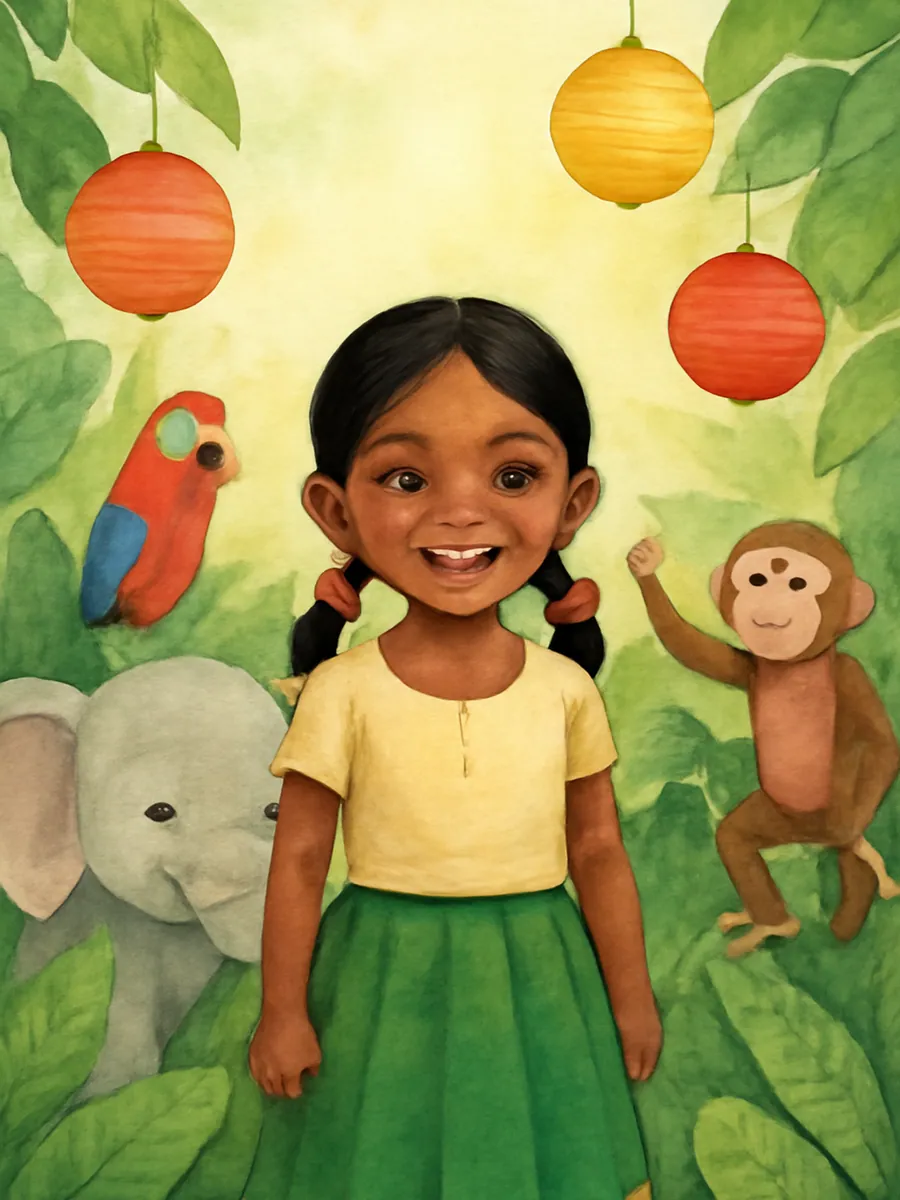
Kids storybooks: bedtime stories
Krishna stories for kids: short tales to read aloud tonight, and what each one teaches
The best Krishna stories for young children are the gentle ones from his childhood in Gokul and Vrindavan: the butter pots, butter for the monkeys, the flute under the kadamba tree, the rope that was always too short, and the day he lifted Govardhan hill. Each takes two or three minutes to tell and carries one clear idea, like sharing, honesty, courage or friendship. Below are eight short retellings, grouped by age, with what each one teaches and a question to ask afterwards.
- Start with the butter and flute stories for ages 2 to 4: they are funny, short and have no scary parts.
- Kaliya and Govardhan are brave stories that suit ages 5 to 8, told calmly and without dwelling on danger.
- One story a night, followed by one question, works better than reading three in a row.
- Families, regions and communities tell these stories differently, so use the names and details your family uses.
- Reading aloud together from a printed book supports language and closeness, according to the American Academy of Pediatrics 5.
Where these stories come from
Most of the stories of Krishna as a little boy come from the tenth book of the Bhagavata Purana, and artists have painted them for centuries 23. A page painted in Mathura around 1520 to 1530 shows two of them side by side: Yashoda chasing naughty Krishna, and Krishna handing out butter to the monkeys 2.
Every family has its own way of telling them. Some say Kanha, some say Krishna or Bhagwan, and a Nani in Udupi and a Dadi in Mathura will tell the butter story with different details. The versions below are short and gentle, written for reading aloud. Change any word to match how your family tells it.
Three gentle stories for ages 2 to 4
1. The butter pots up high. In Gokul, Yashoda Maiya churned fresh white butter every morning, and little Kanha loved it more than anything. So she hung the pots from the ceiling, far out of reach. Kanha was not worried. He and his friends stacked pots one on top of another, climbed up and helped themselves 1. When Yashoda found him, his cheeks were covered in butter. "Not me," he said. She tried very hard to look cross, and then she laughed and hugged him. What it teaches: a mother's love is bigger than any mischief, and it is always better to tell the truth.
2. Butter for the monkeys. One day Kanha found a full pot of butter. Instead of eating it all, he looked out of the window. The monkeys looked hungry. The calves looked hungry. His friends looked very hungry. So he shared it, one handful for each, until the pot was empty and everyone was smiling 2. What it teaches: good things feel even better when we share them.
3. The flute under the kadamba tree. In the evening, when the sun went orange, Kanha sat under the kadamba tree and played his flute. The cows stopped eating grass and came to listen. The calves lay down. The peacocks spread their feathers and danced. Then, slowly, everyone walked home together for the night. What it teaches: quiet, gentle moments matter, and animals feel kindness too. A good last story before lights out.
Two stories full of wonder for ages 4 to 6
4. Open your mouth, Kanha. Kanha's friends ran to Yashoda. "Kanha ate mud," they said. Yashoda knelt down and said, "Open your mouth." Kanha opened it wide, and inside she saw not mud but the whole sky: the sun, the moon, the stars, mountains, rivers and oceans, the entire world. She blinked, and it was just her little boy again, grinning. She picked him up and held him close. What it teaches: there is far more to people than we can see, and wonder can be found anywhere.
5. The rope that was always too short. After one especially naughty morning, Yashoda decided to tie Kanha to a heavy wooden mortar so he would stay put. She wrapped a rope around his waist, but it was two fingers too short. She added another rope. Still two fingers short. She brought every rope in the house, and still it would not reach. Only when Kanha saw how tired she was did he let the rope fit. This is why Krishna is also called Damodar, the one with a rope around his waist. What it teaches: love works better than force, and keeping at something matters.
Three brave stories for ages 5 to 8
6. Kaliya in the river. A huge many-headed snake called Kaliya came to live in a pool by the Yamuna, and its poison spoiled the water. The cows and birds that drank from it fell sick 4. Kanha jumped in. He wrestled the snake, climbed onto its heads and danced on them until Kaliya asked to be set free 4. In most tellings, Kanha lets him go on the promise that he will leave, and the river is clean again. What it teaches: being brave means standing up to protect others, and forgiving someone who says sorry. Tell the fight in one or two lines and spend longer on the clean river at the end.
7. The hill that became an umbrella. Every year the cowherds of Braj made an offering to Indra, the king of the gods. One year they did not, and Indra sent rain so heavy the whole village flooded 3. Kanha walked to Govardhan hill, lifted it up and held it over everyone, so the families, cows and calves could all take shelter underneath 3. In many tellings he held it on one little finger for seven days until the rain stopped. What it teaches: we look after each other in hard times, and even a small person can do something big.
8. Sudama's handful of rice. This story comes from later, when Krishna was grown up and lived in a palace in Dwarka. His old school friend Sudama was very poor. He walked all the way to Dwarka with only a small bundle of beaten rice as a gift, feeling shy about it. Krishna ran to hug him, sat him down like an honoured guest and ate the rice happily, saying it was the best gift he had ever had. When Sudama got home, his little hut had turned into a fine house. What it teaches: real friends care about you, not what you can give them.
What each story teaches, at a glance
Ages are only a guide. Plenty of eight year olds still ask for the butter pots.
| Story | Best for ages | What it teaches | Ask after reading |
|---|---|---|---|
| The butter pots up high | 2 to 4 | Honesty, a mother's forgiving love | What is the yummiest thing you would climb up to reach? |
| Butter for the monkeys | 2 to 4 | Sharing | Who would you share your favourite treat with? |
| The flute under the kadamba tree | 2 to 4 | Calm, kindness to animals | Which animal would come to listen to you? |
| Open your mouth, Kanha | 4 to 6 | Wonder | If someone looked inside you, what would they see? |
| The rope that was always too short | 4 to 6 | Love over force, patience | What did Kanha notice that made him stop? |
| Kaliya in the river | 5 to 8 | Courage, protecting others, forgiveness | Why do you think Kanha let Kaliya go? |
| The hill that became an umbrella | 5 to 8 | Helping each other | Who looks after you when it rains hard? |
| Sudama's handful of rice | 5 to 8 | Friendship | What is the best gift a friend has given you? |
How to read them aloud so they stick
The American Academy of Pediatrics recommends reading together from birth through at least kindergarten. It says shared reading builds a foundation for language, literacy and social-emotional development, and suggests making books part of the bedtime routine 5. It also notes that printed books lead to more back-and-forth between parent and child than digital ones 5. A Krishna story at bedtime does all of this, with roots thrown in.
- Tell one story a night and repeat favourites. Young children love hearing the same story many times.
- Give them a line to say. "Not me," from the butter story, or "Open your mouth" works well.
- Pause before the turn in the story and ask, "What do you think happens next?"
- Use the words your family uses: Kanha or Krishna, Maiya or Ma, makhan or butter, in Hindi, Tamil, Bangla or any language you speak at home.
- End with the question from the table and let them answer in their own way.
Stories you may want to save for later
Some well-known Krishna stories have frightening parts, like the demons sent by Kamsa to harm baby Krishna, or the final battle with Kamsa himself. Others, like the stories of Krishna and the gopis, are usually understood as devotional poetry, and many families wait until children are older. The Mahabharata and the Gita belong to Krishna's adult life and suit older children best.
There is no rule here. Some families tell the story of Krishna's birth, with Vasudeva carrying the baby across the stormy Yamuna, to children as young as three. Go with what feels right in your home. For more on pacing mythology by age, read our guide on introducing Indian mythology to young children.
For Janmashtami, and every other night
Janmashtami, the festival of Krishna's birth, is when many families retell these stories, and how it is marked differs from home to home: singing, a decorated cradle, a temple visit, a family meal or a dahi handi in the neighbourhood. These stories are not only for the festival, though. A child who hears about the butter pots in March will still be laughing at them in August.
Chalk Art can lay this out as a book for you: make one here.
Questions
Which Krishna story is best for a toddler?
Start with the butter pots or butter for the monkeys. They are short, funny and have no scary parts, and toddlers enjoy joining in with a repeated line like "Not me." The flute story is a calm one to end the night with.
Where do the stories of baby Krishna come from?
Most of them come from the tenth book of the Bhagavata Purana, and artists have painted them for at least five hundred years . Many regional languages have their own versions too, so the details you grew up with may differ from these.
Is it fine if our family tells the story differently?
Yes. Practice varies by family, region and community, and these retellings are meant to be changed. Use the names, foods and details your family already uses.
How do I tell the Kaliya story without scaring my child?
Keep the fight to a line or two, then spend more time on the ending: Kaliya asks to be set free, Kanha lets him go and the river is clean again. If your child is sensitive, wait until they are five or six.
How many stories should I read in one go?
One a night is enough for most children under six. Follow it with one question and let them talk. Repeating a favourite is good: children often want the same story again and again.
Sources
- Krishna Dances and Holds Aloft Two Stolen Balls of Butter, Philadelphia Museum of Art. Accessed 31 October 2026.
- Yashoda taking after the naughty Krishna with a stick; and Krishna Distributes Butter to the Monkeys, Harvard University, Mapping Color in History. Accessed 31 October 2026.
- Krishna Lifts Mount Govardhan, from a Bhagavata Purana, The Cleveland Museum of Art. Accessed 31 October 2026.
- Leaf from a Kalighat album: Krishna quells the serpent Kaliya (verso), The Cleveland Museum of Art. Accessed 31 October 2026.
- Beyond Literacy: Shared Reading Starting at Birth Offers Lifelong Benefits, American Academy of Pediatrics, HealthyChildren.org. Accessed 31 October 2026.