Milestone ceremonies
Sathabhishekam and Sahasra Chandra Darshan: meaning, age and rituals
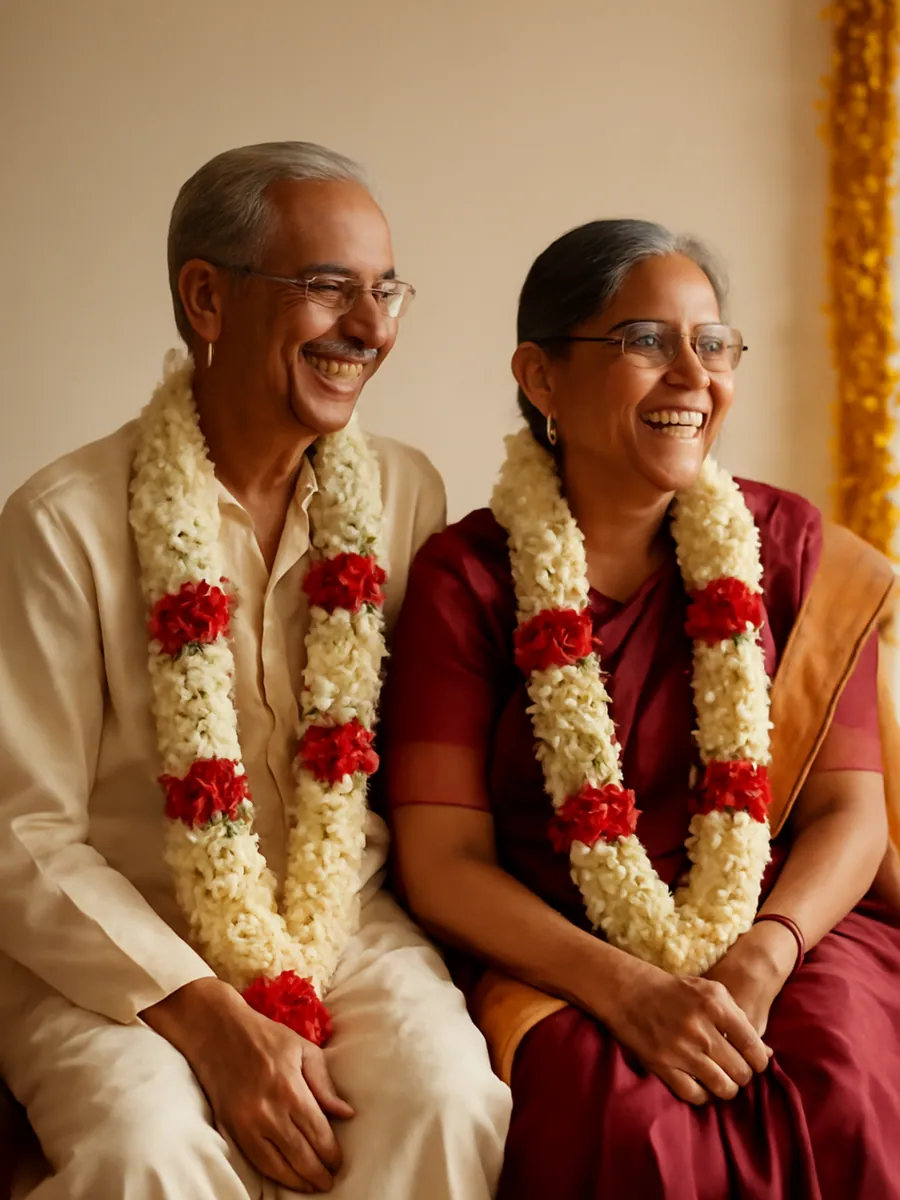
Sahasra Chandra Darshan celebrates the 1,000th full moon of a person's life 1. A lunar month averages about 29.53 days 2, so 1,000 of them come to roughly 80 years and 10 months 1, though many families hear it quoted as 80 years and 8 months. Sathabhishekam is the name many families, especially in South India, give to the 80th year ceremony, often held for the couple together with a renewal of vows 5. Use the birth date to find a rough window, then ask your family priest to fix the day.
- Sahasra Chandra Darshan, also called Sahasra Purna Chandrodayam, marks a person's 1,000th full moon 1.
- 1,000 lunar months of about 29.53 days each come to roughly 80 years and 10 months 12. The popular figure of 80 years and 8 months comes from a rougher rule of thumb.
- To estimate: add 80 years, 9 months and 5 days to the birth date. The 1,000th full moon falls within about 30 days after that. Your priest fixes the actual day.
- Sathabhishekam usually includes homams, kalasa pujas, abhishekams, blessings from elders and, for couples, a renewal of marriage vows 5.
- Names, timing and rituals vary by family, region and community. Treat every age figure here as approximate.
What Sathabhishekam and Sahasra Chandra Darshan mean
Sahasra Chandra Darshan means seeing a thousand moons. It marks the 1,000th full moon in a person's life and is also known as Sahasra Purna Chandrodayam or Chandra Ratharohan 1. Families see it as a prayer for strength of body and mind in old age 1.
Sathabhishekam is the name many families, especially in South India, use for the 80th year celebration. Temples that conduct it describe Vedic rituals, homams, kalasa pujas and abhishekams, with blessings from elders and family members taking part 5. Some families treat Sathabhishekam and Sahasra Chandra Darshan as one occasion. Others hold them separately, a few months apart. Both are right: practice and experience vary by family, region and community.
Both belong to a longer line of later-life ceremonies that starts with the 60th birthday. If you are planning that one, our note on Shashtipoorthi meaning, age and rituals covers it.
Why 1,000 full moons lands around 80 years and 8 to 10 months
A full moon comes round roughly every 29.53 days, the average length of a lunar month 2. That is shorter than a calendar month, so a solar year holds a little more than 12 full moons. The Hindu lunar calendar handles the gap by adding an extra month, the adhik maas, about every 32.5 months on average 3.
There are two ways people do the sum, and they give slightly different answers.
- One rule of thumb behind 80 years and 8 months: 80 years times 12 moons is 960. Assume one adhik maas every two and a half years, which adds 32. That makes 992, so 8 more moons are needed, giving 80 years and 8 months. Some families quote it as 80 years, 8 months and 8 days.
- The closer average (about 80 years 10 months): with one adhik maas every 32.5 months 3, 80 years add only about 29 or 30 extra moons. Ten or eleven more are then needed. Multiplying 1,000 by 29.53 days gives about 29,530 days, the same answer of roughly 80 years and 10 months 1.
- The timing many families follow: the celebration is traditionally held about three full moons before the 81st birthday 1, which falls in the same window.
- A common slip: counting only 12 full moons a year pushes the date close to 83 years. That leaves out the extra months, so it is too late.
How to estimate the date from a birth date
The first full moon of a life comes some time in the first month after birth. The 1,000th comes 999 lunar months later, which is about 29,501 days 2. So the 1,000th full moon falls between about 29,501 and 29,531 days after birth: roughly 80 years, 9 months and 5 days, to 80 years and 10 months.
You can find this window at home with just the birth date. Here is how it works for a fictional example, Meenakshi Subramanian, born on 15 March 1946.
| Step | What to do | Example: born 15 March 1946 |
|---|---|---|
| 1 | Add 80 years, 9 months and 5 days to the birth date. This is the start of the window | 20 December 2026 |
| 2 | Add about 30 days. This is the end of the window | 19 January 2027 |
| 3 | Look up the full moon (purnima) that falls in this window in a calendar. That is roughly the 1,000th | One purnima between 20 December 2026 and 19 January 2027 |
| 4 | Take the window to your family priest | The priest fixes the day the family will observe |
What usually happens at the ceremony
The shape of the day differs from home to home, but temples that conduct Sathabhishekam describe a common pattern. The ceremony runs for several hours, so families are asked to book in advance and arrive early 5. The list of items needed also depends on the priest's instructions and the family's traditions 5.
Some families also choose a temple linked with long life. At the Amritaghateswarar-Abirami temple in Thirukkadaiyur, Tamil Nadu, worship is believed to bring long life to couples who have reached sixty or eighty-one, a belief tied to the story of young Markandeya, whom Shiva saved from death 4.
- Pujas: the priest begins with prayers and performs kalasa pujas over pots of water 5.
- Homams: fire offerings for health and long life 5.
- Abhishekam: a ritual bath, usually for the elder or the couple, with water from the kalasams 5.
- Renewal of vows: for a couple, the ceremony often includes a renewal of marriage vows in front of family 5. Many families describe it as the couple's second wedding.
- Blessings: children, grandchildren and relatives take part and receive the elders' blessings 5. Many touch the elders' feet.
- A meal: most families end with a feast for guests, and some add charity such as feeding people in need.
How the names and timings differ
The same stage of life goes by different names, and families draw the lines in different places. You may hear Sathabhishekam, Sahasra Chandra Darshan or Sahasra Chandra Darshana Shanti, and some families use more than one of these words for a single function. Names vary by family, region and community.
The table lists the later-life ceremonies with the timings most often quoted 1. Your family's custom may differ.
| Ceremony | Commonly quoted timing | Notes |
|---|---|---|
| Shashtipoorthi (Shashtyabdapoorthi) | 60 years 1 | Often the first big later-life ceremony |
| Bhimaratha Shanti | 77 years, 7 months, 7 days 1 | Some families mark it at a different age |
| Sathabhishekam | Around the 80th year | Often held for the couple together, with a renewal of vows 5 |
| Sahasra Chandra Darshan or Sahasra Purna Chandrodayam | 1,000th full moon, about 80 years 8 to 10 months 1 | Often combined with Sathabhishekam |
| Devaratha Shanti | 88 years, 8 months, 8 days 1 | Less common, and a big family occasion |
| Divyaratha Shanti | 99 years, 9 months, 9 days 1 | Rare, and treasured when it happens |
Planning with an 80 year old's comfort in mind
A long ceremony can be tiring at this age. Ask the priest which parts can be kept short. Arrange a comfortable seat with back support, keep water and a light snack close, and plan the timing around the elder's usual meals and medicines. If your parent has a health condition, check with their doctor about fasting or long sitting. This is general information, not medical advice.
Ask your parents what they want. Some would love a hall full of relatives. Others would rather have a quiet puja at home with the grandchildren. For a timeline of venue, invitations and gifts, our milestone function checklist works for an 80th as well.
- Book the priest and venue early, especially in auspicious months.
- Make a list of relatives who cannot travel, so they can send a message or join on a video call.
- Put one person on camera duty for the abhishekam and the blessings. These moments are over quickly.
- Ask relatives to send original photos, not chat-compressed copies. Here is how to save WhatsApp photos in full quality.
Gift ideas that hold eighty years of memories
Many families give new clothes, a silk saree or veshti, or a piece of silver. One gift people keep coming back to is a collection of messages and old photos from the people whose lives your parents shaped: children, grandchildren, siblings, students and neighbours. A grandchild could write a short note such as: "Thatha, you taught me to read the newspaper aloud every morning. I still hear your voice when I do." Ask each relative for one memory and one photo, and you have a book.
Chalk Art can lay this out as a book for you: make one here.
If your parent would rather tell their own story in their own words, a life story book records it over a few weeks, with their agreement and the freedom to skip any question.
Questions
Sahasra Chandra Darshan at what age is it done?
It marks the 1,000th full moon of a person's life, which falls at roughly 80 years and 9 to 10 months, though many families quote 80 years and 8 months. Some hold it about three full moons before the 81st birthday. The exact day is fixed by the family priest.
Is Sathabhishekam the same as Sahasra Chandra Darshan?
They are closely linked. Sahasra Chandra Darshan is about the 1,000th full moon, while Sathabhishekam is the name many South Indian families give to the 80th year ceremony. Some families combine them into one function and others hold them separately. Practice varies by family, region and community.
Is there a Sahasra Chandra Darshan calculator?
You can make a rough estimate yourself. Add 80 years, 9 months and 5 days to the birth date, and the 1,000th full moon falls within about 30 days after that. Treat any result as approximate and confirm the day with your purohit, since families also go by birth star, tithi and their own calendar system.
Can Sathabhishekam be done at home?
Yes. Many families hold it at home with a priest, while others choose a temple or a hall. Ask the priest what space is needed for the homam and kalasams, and make sure the elders have a comfortable place to sit.
What gift can we give at Sathabhishekam?
New clothes and silver are traditional. Many families also give a keepsake of memories, such as a book of messages and old photos from children, grandchildren and relatives. Ask your parents what they would value most.
What if we missed the exact date?
Many families hold the ceremony a little later because of health, travel or family plans. Speak to your priest about a suitable day. The blessings and the gathering matter more to most families than the exact date.
Sources
- Sahasra Purna Chandrodayam, Wikipedia. Accessed 31 October 2026.
- Eclipses and the Moon's orbit, NASA Goddard Space Flight Center. Accessed 31 October 2026.
- Adhika masa, Wikipedia. Accessed 31 October 2026.
- Amritaghateswarar-Abirami Temple, Wikipedia. Accessed 31 October 2026.
- 60th and 80th birthday celebrations, Hindu Temple and Cultural Society of USA (Sri Venkateswara Temple, Bridgewater). Accessed 31 October 2026.