Milestone ceremonies
Shashtipoorthi: meaning, age and rituals explained
Shashtipoorthi (also shashtiabdapoorthi or shashtyabdapurti) is a Hindu ceremony that marks the completion of 60 years of age 1. It falls at 60 because the traditional Hindu calendar names its years in a cycle of 60 samvatsaras, so at 60 the name of a person's birth year comes round again 2. The main rites are commonly described as a shanti part, with prayers such as Ugraratha Shanti, and a kalyanam in which the couple renew their marriage, often arranged by their children 15. Practice varies by family, region and community.
- The name joins the Sanskrit words for sixty and for the completion of a sixty-year cycle 1.
- The Hindu calendar has 60 named years, called samvatsaras. After the 60th, Akshaya, the names start again from Prabhava 2.
- Ugraratha Shanti is a prayer for a peaceful, fulfilling life after sixty. The kalyanam renews the couple's marriage 1.
- One report from Tamil Nadu notes that the ceremony is usually held on the star (nakshatra) birthday in the birth month, as the husband enters his 61st year, so the date may differ from the calendar birthday. Other families follow other customs 5.
- The temple at Thirukkadaiyur in Tamil Nadu is widely known for the 60th, 70th and 80th year rites 3.
What does shashtipoorthi mean?
Shashtipoorthi comes from Sanskrit. Shashti means sixty, and abdapoorthi means the completion of a cycle of sixty years, which is why the longer name is shashtiabdapoorthi 1. In plain words, it is a thanksgiving for completing sixty years of life.
In traditional Hindu belief a full human lifespan is 120 years, so sixty is seen as the halfway mark 1. The ceremony is often described as a bridge between the busy householder years and a calmer stage of life that leans towards faith and family 1. For many families it is simply the day the children say thank you.
Why is it celebrated at 60?
The answer lies in the Hindu calendar. Traditional Indian calendars give each year a name, called a samvatsara, and there are 60 names in one cycle 2. A samvatsara is tied to the time Jupiter (Brihaspati) takes to move from one rashi to the next. Five rounds of Jupiter through the twelve rashis come to about 60 years, a full samvatsara chakra 2.
The first year of the cycle is Prabhava, the second is Vibhava and the last is Akshaya. Once all 60 are over, the cycle starts again 2. So a person born in a particular samvatsara meets that same year name again at sixty. One full cycle of life is complete, and a new one begins.
This is also why many families do not hold the ceremony on the calendar birthday. One report from Tamil Nadu notes that it is usually held on the star birthday, when the birth nakshatra falls in the Tamil birth month, as the husband completes 60 and enters his 61st year 5. Other families follow other customs.
The main rituals: Ugraratha Shanti and the kalyanam
The ceremony is commonly described in two parts, shanti rites and kranti rites, and is often spread over two days 1. The exact steps and the number of priests differ from family to family, so treat what follows as a common pattern, not a fixed rule.
Ugraratha Shanti. This is the heart of the shanti part. It is a prayer offered so that the years after sixty are spiritually fulfilling 1. The rites usually include a purification called punyaha and kalasha sthapana, the setting up of sacred pots of water for deities such as Maha Ganapati, the nine grahas, Mrityunjaya and the family deity 1. Puja, mangala aarti and the Navagraha and Ganapati homas are also part of it 1. Temple guidance for the 60th birthday lists homams, kalasa pujas and abhishekams, with three large and nine small kalashas 4.
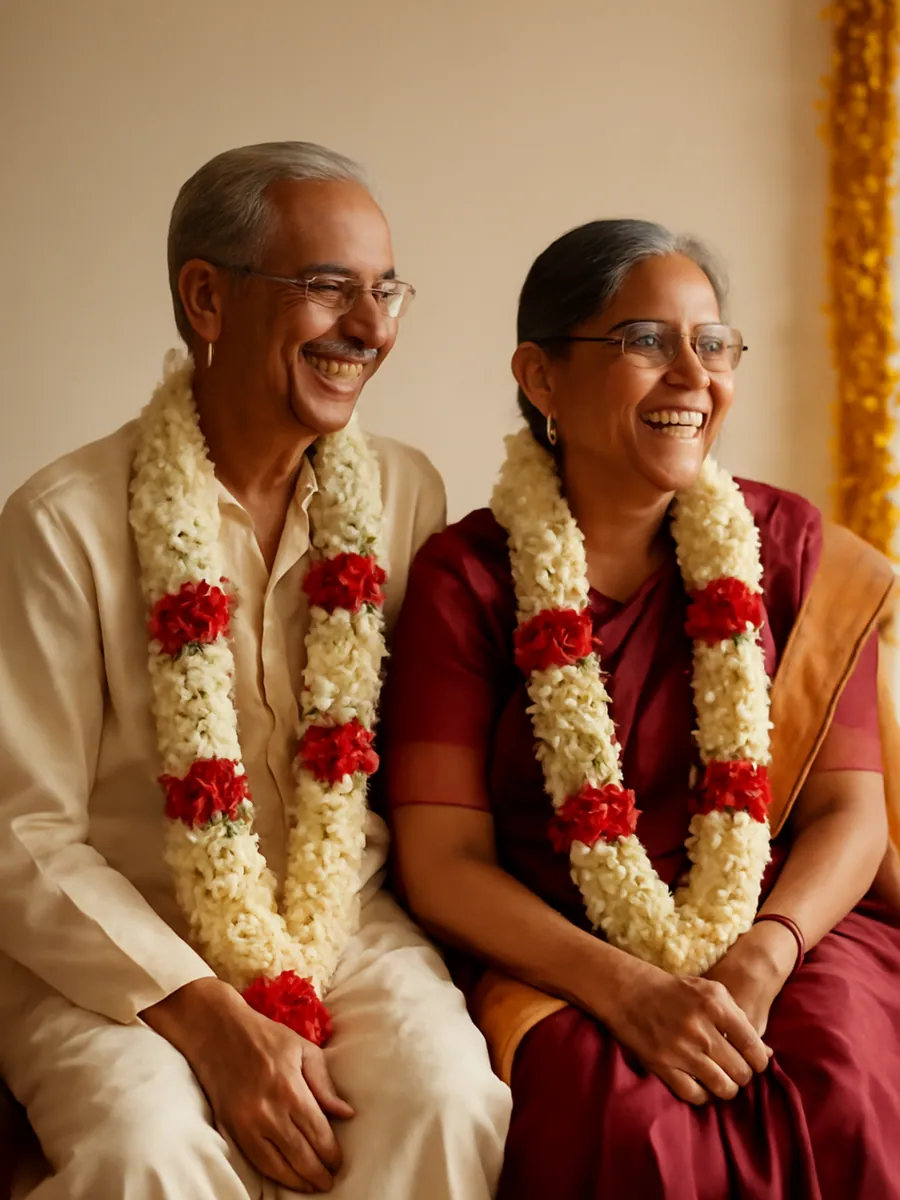
The kalyanam. The kranti part marks the move into a new stage of life. Its centre is a ceremonial wedding in which the couple reaffirm their marriage 1. One temple describes it as a renewal of marital vows in front of family 4. Garlands are exchanged as at a wedding, and children, in-laws or younger relatives usually do the organising 5. For many families this is the moment everyone remembers.
Regional names and spellings
The ceremony is best known in South India, and the name changes with the language and with whoever is spelling it. These are the names you are most likely to see on an invitation or a temple board. If your family uses another name, it is very likely the same occasion.
| Language or use | Name | Where you may see it |
|---|---|---|
| Sanskrit | Shashtyabdapurti or shashthipurti | Scriptural and priestly use 1 |
| Telugu | Shashtipoorthi | Telugu-speaking families 1 |
| Tamil | Manivizha | Tamil-speaking families 1 |
| Tamil temple usage | Shastiapthapoorthi or sashtiapthapoorthi | Temples and news reports in Tamil Nadu 35 |
| Temple guidance in English | Shashti Poorthi | Temple booking and puja pages 4 |
How it fits with the 70th and 80th year rites
Shashtipoorthi is often the first of a series of later-life ceremonies. The Amirthakadeswarar temple at Thirukkadaiyur, near Karaikal, is known for all three, which are described there as Ayul Shanthi fire worships, prayers for long life 3. The temple is linked with the story of Markandeya, the young devotee who held on to the Shiva lingam when Yama came for him. Shiva saved the boy and told Yama to leave him alone 3. That story is why couples come here to pray for a long life together.
| Age | Ceremony | What it marks |
|---|---|---|
| 60 | Shashtipoorthi (shastiapthapoorthi) | Completion of one 60-year cycle 13 |
| 70 | Bhimaratha shanti | The 70th year 3 |
| 80 | Sathabhishekam | The 80th year 3. See our sathabhishekam guide |
How families celebrate today
Some couples still travel to a temple such as Thirukkadaiyur for the full rites 3. Many others hold the puja at home or in a small hall, with the homas in the morning and lunch for relatives after. A few keep only the kalyanam and a dinner. There is no single right way.
The ceremony can also bring a whole community together. In 2022, 108 former students of a government boys' school in Kallakurichi, Tamil Nadu, who had studied together in 1977 to 1978, held a joint sashtiapthapoorthi with their wives. Their children and grandchildren came to watch 5.
Today the children usually do the organising, often across cities and countries, with someone abroad joining on a video call. If you want to honour a mother's 60th, or a parent who is widowed or single, ask your purohit how your family's tradition can mark it.
Keeping the memory
Within a week of the function, write down who came, what the priest said and the small funny moments. Ask relatives to send their photos while they still have them on their phones. If you are still planning, our shashtipoorthi function checklist covers the weeks before.
Chalk Art can lay this out as a book for you: make one here.
Chalk Art can lay this out as a book for you: make one here.
Questions
Shashtipoorthi kis age mein hoti hai?
Shashtipoorthi marks the completion of 60 years. In some families, as one report from Tamil Nadu notes, it is held on the star birthday in the birth month as the person enters the 61st year, so the date may not match the calendar birthday. Your family purohit can confirm the date.
What is the difference between shashtipoorthi and shashtiabdapoorthi?
They are the same ceremony. Shashtiabdapoorthi (shashtyabdapurti) is the full Sanskrit name, meaning the completion of a sixty-year cycle. Shashtipoorthi, sashtiapthapoorthi and manivizha are common shorter or regional names.
What is Ugraratha Shanti?
Ugraratha Shanti is the main prayer of the shanti part of shashtipoorthi. It is offered so that the years after sixty are spiritually fulfilling. It usually comes with kalasha sthapana and homas such as the Navagraha homa, though the exact steps vary by family.
Why do couples get married again at shashtipoorthi?
The kalyanam marks the couple's move into a new stage of life and renews their marriage. In many families the children organise it, and the couple exchange garlands as at a wedding.
Can shashtipoorthi be done at home?
Yes. Many families hold the puja and homas at home or in a small hall with a family purohit, while others go to a temple such as Thirukkadaiyur. Ask your purohit what your tradition needs and plan around that.
Sources
- Shashthipurti, Wikipedia. Accessed 31 October 2026.
- Samvatsara, Wikipedia. Accessed 31 October 2026.
- Amirthakadeswarar Temple, Thirukkadaiyur, Karaikal District Administration. Accessed 31 October 2026.
- 60th and 80th birthday celebrations, Hindu Temple and Cultural Society of USA (Sri Venkateswara Temple, Bridgewater). Accessed 31 October 2026.
- 108 former students of a school celebrate sashtiapthapoorthi together, ETV Bharat. Accessed 31 October 2026.